Please note: this Brain and Music Blog has moved! Our new address is www.HealingMusicEnterprises.com/brain_blog See you there!

Wednesday, May 30, 2007

Musicians set the tone for healing

The many applications of music for healing: hospice settings, coma, stroke and rehab of all kinds. Enjoy this fabulous story:

Anna Jenkins wears a solemn expression while she gracefully plucks the strings on her harp. The notes fill the room and coat it with an aura of peace.
Next to her, in a hospital bed, a patient is dying.
Jenkins is one of a handful of music therapists who volunteer at St. Francis Hospital in Federal Way.
“I usually am serious because I’m playing for people that are very sick,” Jenkins said.
The notes are dream-like and seem to float from the harp, following no recognizable melody. To play a song a person recognized would hold them in reality, Jenkins said. An unfamiliar song helps people let go.
“They can just listen to that and drift off,” she said. “Music helps people to let go and if they’re actively dying, their hearing is the last thing that stays with them.”
Jenkins doesn’t only play for those who are dying. She also plays to relax those who are critically or chronically ill. She plays for children and the elderly as well as patients just coming out of a difficult surgery. Music helps heal, Jenkins said.
She recalled a story from two years ago. She was playing the harp at a comatose patient’s bedside while the family gathered around singing hymns. The man suddenly awoke from a coma.
It could have coincidentally been his time to wake up, but Jenkins likes to think otherwise.
“I couldn’t help but wonder if the love from all his family there somehow reached him,” she said.
For those who are dying, Jenkins spends a considerable amount of the afternoon playing her harp at their bedside. A story in the Bible mentions angels playing the harp at a person’s death.
“There are rare occasions where it’s a little scary for people,” Jenkins said. “They say ‘Oh no, I’m not ready for that.’”
Although Jenkins insists she is not an angel, she said there is often a spiritual presence in the room when she plays.
“I’ve had people comment that they’ve been touched by the spirit. I don’t want to imply that it’s me, but it’s something that happens in the room at the time,” she said.
Soothing music reduces a patient’s blood pressure, relieves anxiety and affects the heart rate, said Renee Krisko, a chaplain at St. Francis. Krisco assigns Jenkins and other music therapists to patients who would most benefit from the music.
“I believe there are medical healing effects to this,” she said.
Jenkins said she’s watched a person’s heart rate go down on the monitor while she’s playing. She was trained in music therapy as part of the Music for Healing and Transition program.
Although most people will never have the opportunity to hear Jenkins play the harp, all visitors to St. Francis could meet Bonnie Knight-Graves.
Graves volunteers to play the piano in the lobby and in the mental health ward at St. Francis several days each week.
“It’s serving the public, actually,” Graves said of her work. “It’s setting the tone for people coming into the hospital.”
Music is healing because it relieves a patient’s anxiety, Graves said.
“It frees the mind of stress and gives them a more relaxed approach to life so they can heal themselves,” she said. “The body can heal itself if it’s not loaded down with stress.”

Tuesday, May 15, 2007

Born with a 'music module'?

This is an excerpt from a fascinating interview:


JEFFREY BROWN: Music, of course, comes in many forms and appears to have been part of every age and every known culture. There's a continuing debate among scientists as to music's exact role in human evolution.
But Levitin believes that the brain itself has evolved to make sense of music and that we're each born wired for music, just as we are for language.
DANIEL LEVITIN: If you're born listening to Chinese opera, your brain is going to become wired to the rules of that musical form. If you're born listening to Pakistani music, Indian music, Indian ragas, your brain will become wired to those. Our brain is plastic, and malleable, and able to wire itself up to whatever language we hear, to learn those rules.
Similarly, I would argue that we all are born with a music module. We're born with the wiring to accommodate any music that we hear, and we learn those rules effortlessly just by listening.
JEFFREY BROWN: Levitin says there's an area of the brain, in the prefrontal cortex, specifically dedicated to comparing what we hear with our expectations of learned patterns of music. That's the reason we can be surprised, pained or delighted when those expectations are tampered with, something great musicians know to exploit.
DANIEL LEVITIN: When you listen to Stevie Wonder drumming on "Superstition," for example, he's playing in time, and you're forming predictions about what's going to happen next. The additional nuance that he brings to it is that he changes the beats ever so slightly, throughout the whole song, "Superstition," never the same.
So he's going a little bit different. He varies the pressure on the high-hat cymbal, so it's a little bit louder, a little bit softer. The beauty of it is that the cerebellum is trying to figure out, "OK, where is the next beat going to come? What's it going to be?" And he's surprising the cerebellum at every turn, so that your brain...
JEFFREY BROWN: We don't talk to too many scientists who are doing Stevie Wonder drum solos for us, I've got to tell you that.

Sunday, April 29, 2007

Music, the Brain, and Exercise

"It's no secret that exercise improves mood, but new research suggests that working out to music may give exercisers a cognitive boost.Listening to music while exercising helped to increase scores on a verbal fluency test among cardiac rehabilitation patients." Thus says a study from 2004 as cited in Science Daily. "This is the first study to look at the combined effects of music and short-term exercise on mental performance," said Charles Emery, the study's lead author and a professor of psychology at Ohio State University.

Do you listen to music while you exercise? It seems to me that most everyone at the gym has their ipod on or headphones of some kind or another. Now we have another motivation to listen to our favorite music while exercising. What kind of music do you listen to when exercising?

Friday, April 06, 2007

Neurochemicals at work in Carnegie Hall


I've spent the past week in NYC doing two major musical activities. On Tuesday night I heard my youngest sister conduct her orchestra in Carnegie Hall. It was a true peak experience and the positive neurochemicals such as serotonin and dopamine were surely flowing in abundance! My mother and another sister were there and we were just thrilled to see her conduct just likee pros! It was sooo awesome!


On Thursday morning, I spoke at Lutheran Medical Center in Brooklyn. My topic was "The Importance of Music with Pregnancy, Preemies, and Newborns." The presentation was well-received and I thoroughly enjoyed giving it to the doctors and nurses there! We talked about the effect of music on the devleoping infant's brain and how very important it is to have high quality music for a pregnant Mom!


Questions anyone?

Wednesday, March 21, 2007

Another bike-riding brain-music experience


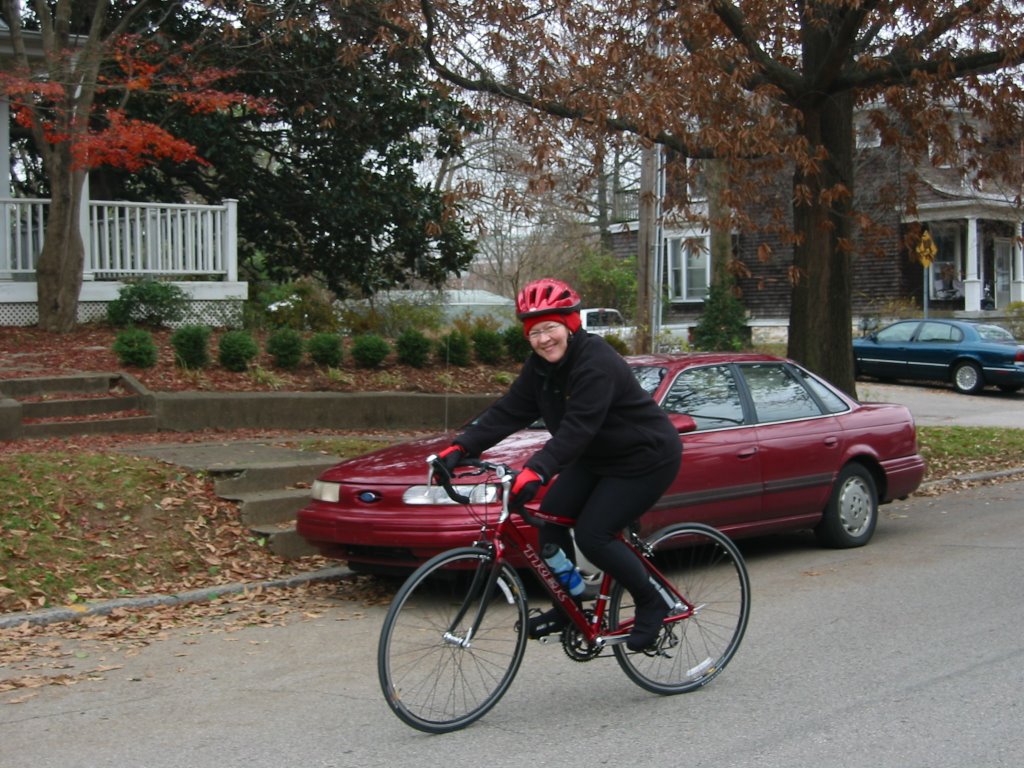
It appears that Spring has sprung here in Louisville, KY and today I decided to get my new bike out again and go for a ride. I was riding with a friend so I wasn't expecting any problems but after we had been out for 30 minutes or so, we encountered a pretty good little hill. The shifters on this bike are different from my old bike so I was trying to climb this hill in a gear that was way too big. I used my old technique of singing to my "one little two little three little indians" and that again worked amazingly well. It took my mind off the struggle of pushing the pedals down so I could make it up the hill and a few minutes later, I figured out my new shifters!

Saturday, March 10, 2007

The Brain Goes to Riverdance


Tonight I'm going to Riverdance and I can't wait! I love Riverdance and I can't exactly tell you why. There is a fascinating theory out there that we respond biologically and neurologically to music that is in our DNA. In other words, if we have a heavy Irish heritage, this beautiful Irish music is literally in our blood and in our genes. My immediate family is actually mostly English but that's pretty close. Of course the faster numbers are extremely rhythmic and have the whirling rhythms that make me want to jump up and join them. Since I am in the last row of the last balcony I will try to restrain myself! I'll let you know later how it goes!

Sunday, February 25, 2007

Interesting research


I've reently discovered a great site called www.cognews.com. On this site there was a press release of some very interesting research on how the brain responds to music from other cultures. Let me share this with you, my readers: Subjects brains were observed through an fMRI while listening to music from different cultures. Results showed that brain activation was the same, regardless of cultural bias of the music; although, there were some differences in ability to remember certain kinds of music and brain activation varied based on musical training.
The researchers found similarities in brain activity when the musicians and untrained listeners were exposed to the Western classical and traditional Chinese musical excerpts. All subjects showed significant clusters of activation in the brain regions called the right transverse temporal gyrus and left superior temporal gyrus. However, some differences did emerge based on musical training. The musicians exhibited significantly greater activity in the right superior temporal gyrus when listening to both types of music. In addition, the musicians also showed significant brain activity in the right middle frontal gyrus when listening to Western music and in the left middle frontal gyrus when hearing the Chinese music. These findings support the idea that formal training influences patterns of brain activity in response to culturally familiar and unfamiliar music, according to the researchers.By contrast, brain activity was similar among all subjects when comparing English speech to Cantonese. There was significant brain activity in the left insula and lesser activity in the left superior temporal gyrus and middle temporal gyrus that was not present while listening to Cantonese.

Saturday, February 03, 2007

The Infant Brain


Did you know that the infant brain can be affected before birth by playing classical music and singing to the unborn child? It's true. The brain is the only organ that can actually be positively affected during pregnancy. The other organs, lungs, stomachs, hearts, ovaries, etc., are pretty much on a genetically pre-determined path and there's little you can do in a positive way to affect the. Research indicates that when the developing fetus hears highly organized music or when the mother sings to him, more neural connections are created in the brain which creates a greater, more complex neural infrastructure. Once baby is born, you have to maintain that rich neural infrastructure with lots of interaction. If you're pregnant or thinking of becoming pregnant, start learning your songs and buying your CD's. Let me know if I can help!

Tuesday, January 16, 2007

Music, the Brain, and Memory


I have been studying the use of music with dementia and Alzheimer's patients for many years, but tonight I want to share with you some exciting information about music and memory for all of us! The following is from http://www.cerebromente.org.br/n15/mente/musica.html<
The power of music to affect memory is quite intriguing. Mozart's music and baroque music, with a 60 beats per minute beat pattern, activate the left and right brain. The simultaneous left and right brain action maximizes learning and retention of information. The information being studied activates the left brain while the music activates the right brain. Also, activities which engage both sides of the brain at the same time, such as playing an instrument or singing, causes the brain to be more capable of processing information.

Saturday, January 06, 2007

Brain Comes Alive to Sound of Music


Brain Comes Alive to Sound of Music - Finding offers hope for variety of cures Los Angeles Times, November 11, 1998

The music that makes the foot tap, the fingers snap and the pulse quicken stirs the brain at is most fundamental levels, suggesting that scientists one day may be able to retun damaged minds by exploiting rhythm, harmony and melody, according to new research presented Sunday (November 1998).
Exploring the neurobiology of music, researchers discovered direct evidence that music stimulates specific regions of the brain responsible for memory, motor control, timing and language. For the first time, researchers also have located specific areas of mental activity linked to emotional responses to music. . . .
The latest findings, presented at a meeting of the Society for Neuroscience in Los Angeles, underscore how music--as an almost universal language of mood, emotion and desire--orchestrates a wide variety of neural systems to cast its evocative spell. "Undeniably, there is a biology of music," said Harvard University Medical School neurobiologist Mark Jude Tramo. "There is no question that there is specialization within the human brain for the processing of music. Music is biologically part of human life, just as music is aesthetically part of human life." . . .
Overall, music seems to involve the brain at almost every level. Even allowing for cultural differences in musical tastes, the researchers found evidence of music's remarkable power to affect neural activity no matter where they look in the brain, from primitive regions in all animals to more recently evolved regions thought to be distinctively human.

Tuesday, December 19, 2006

More benefits to playing music


A few days ago we were talking about the fact that people who listen to music use more of their brain. People who play music use even more of their brain! Right now we're in one of the biggest holidays seasons of all and every one of these celebrations focuses on special music. Want to create warm, wonderful positive memories for your children and grandchildren? Put the music on, or even better, pull out the old sheet music, guitar, violin, flute or whatever! Music reinforces all of the poitive behaviors and thoughts that you are creating every minute of every day. Don't waste a moment!

By the way, I'm having a big holiday sale on my website. If you buy a CD, tape or book, you'll get a free electronic copy of the product and you'll get free shipping though the 25th of this month! I'm also having a special on individual, personal consultations: If you buy a 30-minute consult, you'll get an additional 15 minutes free; if you buy a 60-minute consultation, you'll get an additional 30 minutes free. Don't wait! Go to http://www.healingmusicenterprises.com/NeedSomeLast-minuteGifts.htm

Saturday, December 09, 2006

Want to use more of your brain? Play music!


At the Society for Neuroscience annual meeting in Los Angeles several years ago, Dr. Lawrence Parsons of the University of Texas-San Antonio discussed the results of his research which showed that significantly more of the brain was being used during music making that previously thought. We have been taught for years that most of us use very little of our brain but it's not because we don't want to...it's because we don't know how to access more of it! If playing music will help us use more of our brain, bring out those instruments: drums, piano, horns, harps! Let the music begin!

"An understanding of the brain locations that represent the separate aspects of music will help us identify the neural mechanisms that are specific to music, specific to language and are shared between the two," says Parsons. "The finding that there is a right brain region for notes and musical passages that corresponds in location to a left brain region for letters and words illustrates how a neural mechanism may be present in each of the two brain hemispheres becomes special adapted for analogous purposes but with different information contexts."

Saturday, November 18, 2006

Brains, Bicycles, and Brooks Hill


How does the brain think up music? Why do certain songs just pop into your mind at especially opportune times? Earlier today I was riding my shiny new red bike and I was thinking about a time about 20 years ago when I was doing a bike ride with the local bike club. Somehow I had missed the information that this ride would include a very, very steep hill, nick-named "The Wall." I always hated to get off my bike and walk it up a hill and so I put it in the lowest "granny gear" and stood up to pedal up the steep, steep hill. As I slowed down to a crawl a song popped into my head and I suddenly found myself pedalled in precise rhythm to "one, little two little three little indians..." Over and over I sang this song (internally) as I made my way up this hill. It was amazing how this seemed to give me the rhythm and the purpose and the distraction that I needed. Much sooner than I expected I was at the top of the hill, ego and reputation intact. Amazing!

Tuesday, October 31, 2006

What makes music sound "scary"?

With Halloween just around the corner, I've
been contemplating what makes music scary. Some of my younger
readers may not know that for a couple of decades, movies were silent.
In other words, the audience just read the dialogue at the bottom of the
screen, and a pianist sat to the side of the screen and literally
improvised whatever music seemed appropriate to what was happening on the
screen. This was quite an art and just anyone couldn't do it.
The musician had to be able to represent not only horror and fear but also romance, humor, religious feeling and tremendous joy.

Now that movies have soundtracks, the
music that has been composed for them will be among the classics of
tomorrow. The scary movies have some of the most famous themes.
Two that come to mind immediately are the themes from "Jaws" and "Psycho."
Alfred Hitchcock's Psycho is a definite classic horror film. It's
music, by Bernard Herrmann, truly evokes fear and panic. The famous shower
scene music (the screeching violins) is parodied and copied in media all
over the world.

Of course, most of this music is in a minor
key and incorporates sudden changes of dynamics (louds and softs).
You might also hear unusual instruments such as a digiridoo or perhaps a
sitar. The purpose is to create an atmosphere that is unfamiliar; a
soundscape that disorients and confuses. Have a fun Halloween and
pay attention to the music

Friday, October 13, 2006

How does your brain listen to music?

According to the Harvard Gazette: Your inner ear contains a spiral sheet that the sounds of music pluck like a guitar string. This plucking triggers the firing of brain cells that make up the hearing parts of your brain. At the highest station, the auditory cortex, just above your ears, these firing cells generate the conscious experience of music. Different patterns of firing excite other ensembles of cells, and these associate the sound of music with feelings, thoughts, and past experiences.

I've written quite a bit about how music elicits tremendous emotion when you hear songs from your adolescence or teen years. This music can shift you to a whole different emotional state and place. Now you know a little more about it!

Tuesday, October 03, 2006

Music on the Brain


At the Harvard Medical School, Dr. Mark Tramo is doing research on how music affects the brain. His research also suggests that even babies have specific musical likes and dislikes. The dark stripe on the model brain he holds marks an area particularly sensitive to rhythm, melody, and harmony. The good doctor says that "They begin to respond to music while still in the womb. At the age of 4 months, dissonant notes at the end of a melody will cause them to squirm and turn away. If they like a tune, they may coo. "

"Music is in our genes," says Mark Jude Tramo, a musician, prolific songwriter, and neuroscientist at the Harvard Medical School. "Many researchers like myself are trying to understand melody, harmony, rhythm, and the feelings they produce, at the level of individual brain cells. At this level, there may be a universal set of rules that governs how a limited number of sounds can be combined in an infinite number of ways."
"All humans come into the world with an innate capability for music," agrees Kay Shelemay, professor of music at Harvard. "At a very early age, this capability is shaped by the music system of the culture in which a child is raised. That culture affects the construction of instruments, the way people sound when they sing, and even the way they hear sound. By combining research on what goes on in the brain with a cultural understanding of music, I expect we'll learn a lot more than we would by either approach alone."

Imagine how wonderful it would be if music could provide one powerful path to peace!

Saturday, August 05, 2006

Can Mozart's Music Make you Smarter?

Many of you have probably heard of "The Mozart Effect." The original research, done in California at UC Irvine, showed that Mozart's Sonata in D Major for Two Pianos helped highschool students score higher on the Scholastic Aptitude Test than students who listend to other music before the exam or those listened to nothing. This was exciting news and was widely reported in the media. Later, some marketers began suggesting that Mozart's music actually raised your IQ and "made you smarter." Not true.

Neuromusicologists suggest that Mozart's music may help you to organize your thoughts and may be good to listen before or during a task. It's also beautiful, brilliant music. But it won't make you smarter! Sorry.

Saturday, July 15, 2006

Why are musical memories so powerful?

There is considerable research showing that the music we listen to in our "courting years" is the music that means the most to us in our last few decades of life. Think about it...what did you listen to when you were in high school? Was it the Platters, the Beatles, the Carpenters, Madonna, Cindy Lauper??? It seems that every generation thinks that the music from their courting years is the best. Why? Could it be that when we're "falling in love" in our teen years, the power neurochemicals released in our brains imprint the music in an indelible way?

Think about it...go back in time and let me know what you think!

Alice

www.HealingMusicEnterprises.com
www.SurgicalSerenitySolutions.com

Thursday, July 06, 2006

Music and the EEG

Did you know that you have electricity in your body and your brain? This is not a theory, it's a fact! One of the most important medical tests that exists to diagnose brain problems is the EEG.

Music and the EEG
There have not been many experiments that have looked to see how the brain processes music. Measurements of brain activity using the electroencephalogram (EEG) have shown that both the right and left hemispheres are responsive to music.

Other researchers have recorded neuronal activity from the temporal lobe of patients undergoing brain surgery for epilepsy. During this study, awake patients heard either a song by Mozart, a folk song or the theme from "Miami Vice". These different kinds of music had different effects on the neurons in the temporal lobe. The Mozart song and folk song reduced the activity in 48% of the neurons while the theme from Miami Vice reduced the activity in only 26% of the neurons. Also the Miami Vice music increased the activity in 74% of the neurons while Mozart and folk music increase the activity in only about 20% of the neurons. Some of the neurons had action potentials that kept time with the rhythm of the music. Although these results do show that the temporal lobe is probably involved with some aspect of music, it is unclear exactly how this area of the brain is used in the appreciation of music.
You can read about this and more at http://faculty.washington.edu/chudler/music.html#eeg

Comments and questions welcomed! My website is www.HealingMusicEnterprises.com

Welcome to the Brain and Music!

Scientific research is teaching us more every day about our brains. As a musician and a therapist, the most exciting thing for me is how music affects our brain. It would seem that sometimes music can even heal the brain.

With an increase in diagnoses such as ADD, ADHD, autism and behavior disorders, it is exciting to see that music can be a powerful, non-addictive, non-invasive intervention.

Over the next many months and years, I hope you will post to this blog and tell me your own stories about music and the brain.

See you online!

Dr. Alice H. Cash, LCSW
www.HealingMusicEnterprises.com